
This work starts with people. It always has.
Too many people go through transition on their own, carrying a loss nobody's named, a fog that makes even simple work feel harder than it should, a grief for an ending that never got called what it was, while the organisation around them has already moved on to the next chapter.
Who we are
&Koh was founded by Guy Stephens, who brings three decades of global consulting, learning design, and organisational transformation to this work. Guy specialises in transition agility, drawing on grief literacy as part of that, is a LEGO® SERIOUS PLAY® facilitator and coach, and has his own lived experience of neurodivergence.

That last part matters more than a line on a bio usually does. It means this work isn't only about understanding transition as a system, it's shaped by knowing, firsthand, what it costs to move through change when nothing about the process was designed with your nervous system, your identity, or your relationship to endings in mind.What we believe
People are the ones going through transition, not the ones it happens to. Every restructure, redundancy, merger, or shift in direction asks real people to let go of something that mattered, a role, a team, a routine, a future they'd pictured. When that loss goes unnamed, it doesn't disappear. It builds up, as distraction, as eroded trust, as the quiet exit of people who had the most to give. We think of this as a grief tax, and it's paid by people long before it shows up in any performance report.
Having agency is what steadies people through uncertainty. When people feel they have no real say in what's happening to them, the gap between the official story and how it actually feels widens, and trust goes with it. When people can understand what's happening, make sense of their own situation, and take a next step that's actually theirs, they can hold steady even when things are genuinely uncertain. Most of what we do is in service of that.
The ability to move through change well is built, not assumed. It isn't a personality trait some people have and others don't. It's something that can be developed, and it compounds, so the next transition, and the one after that, gets a little easier to carry.
Designing for every neurotype isn't optional, it's just good design. The weight of transition doesn't land evenly. Neurodivergent people, and people from under-represented groups, often carry more than their share of it, and are too often labelled resistant or low-resilience when the actual problem was a process that only worked for one kind of mind. Everything we build allows for more than one way to take part, make sense of things, and move forward.
This should leave people stronger, not more depleted. Most change extracts from people and systems without giving anything back. We try to work the other way, so that each transition, handled honestly, leaves people and the organisation more able to face the next one. Not more brittle. More grounded.
Where &Koh comes from
The name &Koh comes from somewhere personal.
Koh is a family name, and the name honours where this comes from while still becoming something new. The "&" is really the point, a way of working that's collaborative and curious, built on the belief that meaningful work is always done with people, never just for them.
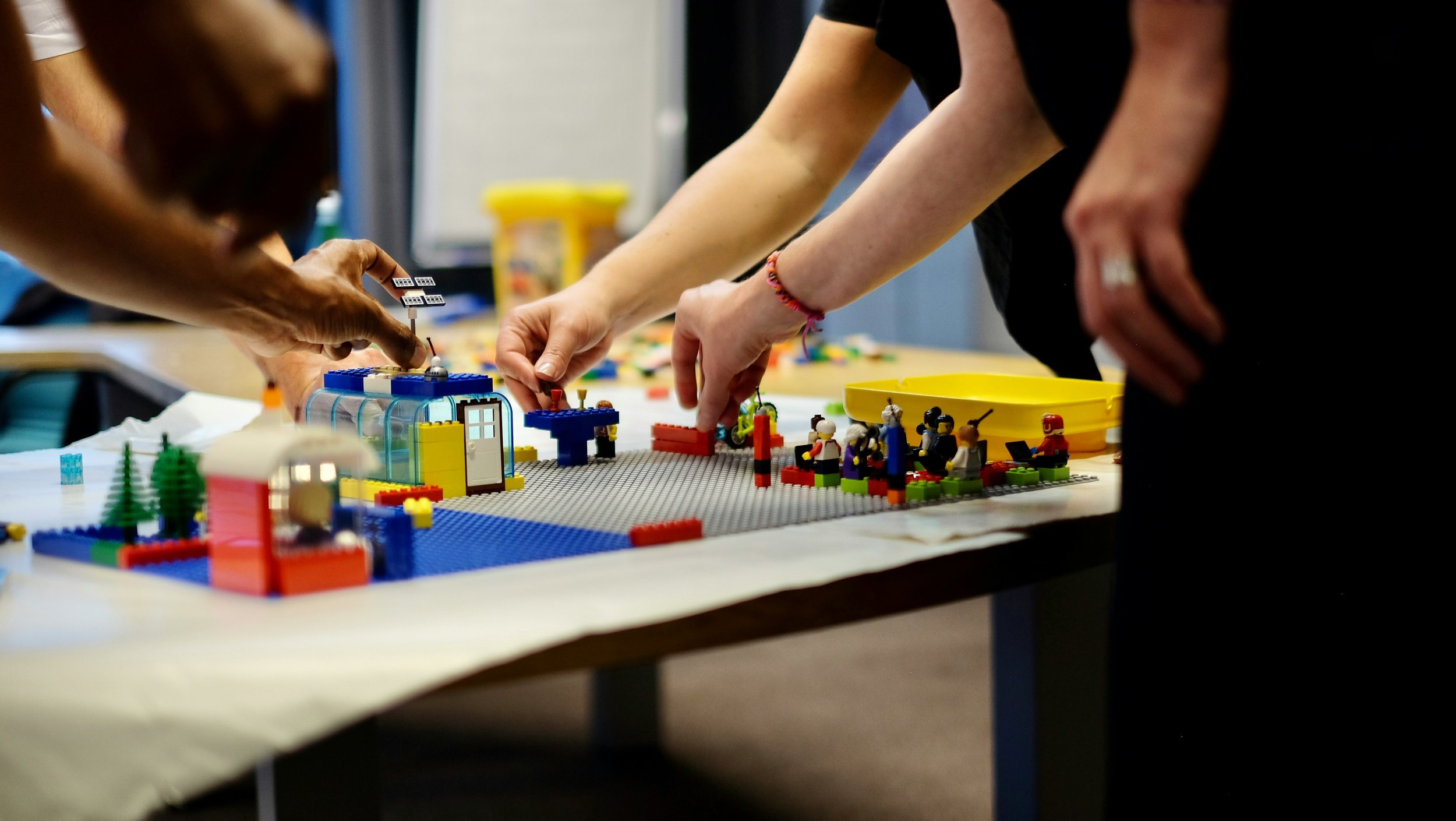
The story goes back decades, to Sunday lunches in Singapore, an extended family gathering to eat, talk, and play. Those afternoons are where the underlying idea comes from: organisations as living systems rather than machines, where play is one of the more honest ways we have of making sense of change together.
That spirit runs through every piece of this work, the LEGO® bricks, the honest conversations, the questions that get underneath the obvious ones, the attention to the wider system. And the belief that right at the threshold between an ending and a beginning, where things feel least settled, there's usually the possibility of something more honest, and more real, starting to take shape.
&Koh, where every journey begins with and.