
&Koh is built on a simple belief: the dynamics that actually shape how people and organisations work are rarely said out loud.
Surfacing those dynamics, in teams, and in the wider systems they sit inside, is the focus of everything here, using LEGO® SERIOUS PLAY® at a systems level as the method for getting there.

This idea has a name: the system of the unexpressed. It's not a service you book on its own, it's the lens everything else here is built on.

&Koh works with people in three ways, depending on where you're starting from.Helping teams build transition agility: the skill of moving through workplace transition well, restructuring, redundancy, or a change in leadership, or the shift to new ways of working with AI, so that each time it happens, the team is better at it than the last. Built on LEGO® SERIOUS PLAY® at a systems level and William Bridges' Transition Model. Start with a low-commitment Block session, or go deeper with Block.Build.Begin.Ongoing development for facilitators and practitioners who already use LEGO® SERIOUS PLAY® and want to sharpen their craft, 1:1, or through organisation-wide capability building.
Start with LSP Remix, a free two-hour introduction to LEGO® SERIOUS PLAY® using your own context, no experience needed and nothing to sign up for afterwards.
Guy Stephens is a certified LEGO® SERIOUS PLAY® facilitator with over 30 years of experience in facilitation, learning and organisational change, including time at IBM, Capgemini, The Carphone Warehouse and Mars.
Change vs transition
Change is the event. A restructure, a merger, a new leader, a redundancy round, and AI rollout. It gets announced, mapped out, and scheduled onto a timeline.
Transition is different. It's what people actually go through in response to the change, and it runs on its own timeline, usually slower than the org chart suggests.
William Bridges, whose work sits behind Make Transition Work, described transition in three phases.
Ending. Letting go of how things were, even when the change itself is objectively for the better.
The Neutral Zone. The in-between. Old ways don't quite work anymore, new ones haven't settled in yet. Uncomfortable, often the longest phase, and the one most organisations rush past.
New Beginning. Genuinely arriving at the new way of working, not just adopting it on paper.
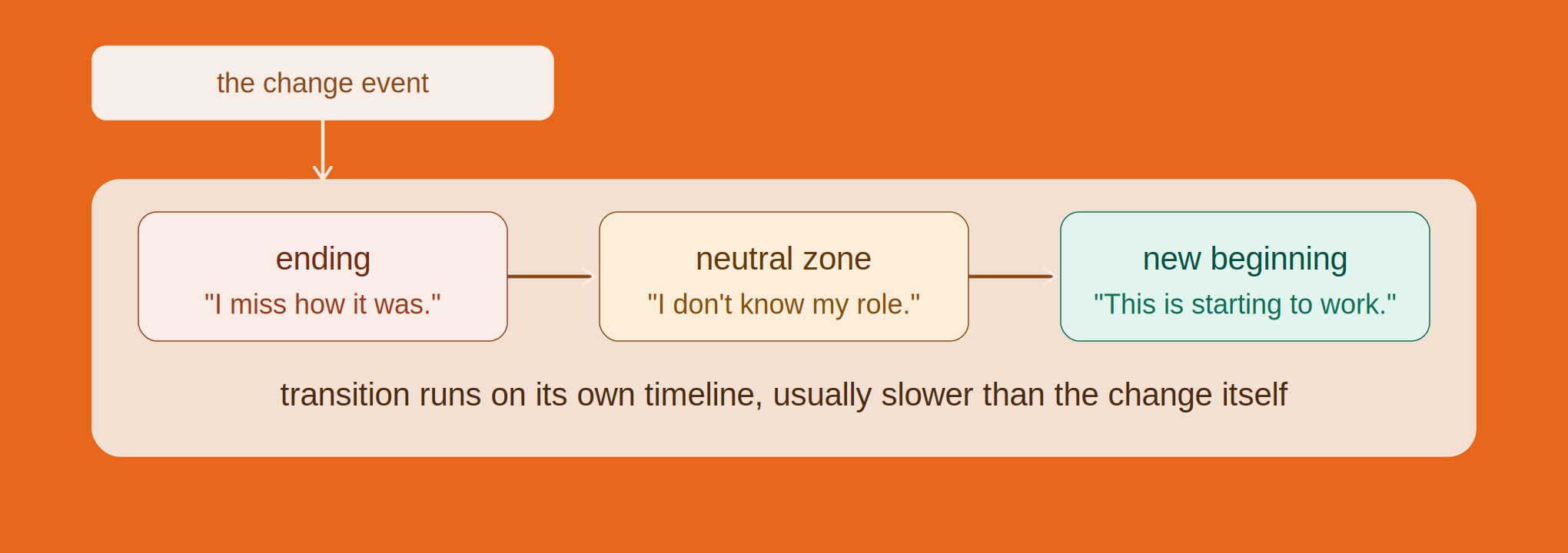
Most change management addresses the event. Few address what a team is actually going through underneath it, in the neutral zone, where people get stuck, where things go unsaid, where everyone quietly fills the silence with their own assumptions about what's really happening. That's often mistaken for resistance or stubbornness, when it's usually just a team genuinely working through something nobody's named yet. Left unaddressed, this is where trust, productivity and morale erode, sometimes for as long as two years. The question worth asking isn't whether your team is resisting change. It's where they actually are in Bridges' Transition Model.
If your team's in the middle of change right now, get in touch and let’s talk.
Start here: Block
Most teams can name the change they're going through. Fewer can name what's actually in their way, and that's rarely because nobody's noticed it. A live, hands-on session, 2–2.5 hours, built in LEGO® SERIOUS PLAY®, where a team surfaces the block together rather than guessing at it alone.