
Every organisation runs on two systems at once.
The one it can describe, the org chart, the strategy deck, the stated process. And the one it can't: the silences, the endings nobody announced, the tension everyone feels and nobody names. We call that second system the unexpressed. It's the thing our work is actually built to work with.The gap between what's said and what's true
Ask a team how it works and you'll get the official version. Ask what actually happens and something else turns up, quieter, harder to point at, often never said aloud at all.
That gap isn't a communication failure to be fixed with better meetings. It's structural, and it shows up at more than one level:
Individually, in the version of someone a system has never made room for, the doubt nobody's tested because everyone treats it as settled.
As a team, in the version of "how we work" a team has agreed to say out loud, versus what's actually true when the door's shut: the tension nobody's named, the decision everyone privately reads differently, the thing the team collectively knows but has never once said to itself. This is the level most of our work actually sits at, a team carries its own unexpressed, distinct from any one person's and distinct from the wider organisation's.
Structurally, in the ending that was never formally announced, the process nobody can explain but everyone still follows.
Relationally, in the connections between people and teams that everyone feels and nobody names: whether something is support or obligation, whether a tension is real or just inherited.
None of this is hidden on purpose, the way a secret is hidden. It's unexpressed because it was never quite in language to begin with, felt rather than stated, assumed rather than agreed. That's why it rarely responds to being talked about directly. It responds to being built.
“
Whenever undiscussables exist, their existence is also undiscussable.
~Chris Argyris
Where the unexpressed does the most damage
It's loudest at the points where something is ending. An unrecognised ending doesn't disappear when the org chart changes, it keeps shaping behaviour and belonging long after the announcement, precisely because it was never properly acknowledged as an ending at all.
That's the direct link to Make Transition Work: teams don't get stuck in transition because they lack a framework. They get stuck because so much of what a transition actually involves, grief, doubt, quiet resistance, the parts of the old way people aren't ready to let go of, never gets a legitimate place to show up. The System of the Unexpressed is the reason Block.Build.Begin work the way they do; it's not a separate idea sitting next to the method, it's what the method is answering.
Not everyone carries the same amount of it
The unexpressed isn't distributed equally across a team. Identity, role, and how someone's mind works all change what's safe to say out loud, and what has to be managed quietly instead.
People from marginalised groups are often penalised for exactly the expression that gets read as "passionate" or "decisive" from someone else.
Neurodivergent colleagues frequently carry extra, invisible labour just to appear "fine" — masking, regulating, translating.
Leaders are expected to model composure; middle managers absorb everyone else's emotion with limited space to process their own; frontline teams often stay quiet because history has taught them it doesn't change anything.
A method that claims to give everyone an equal voice has to actually reckon with this, not assume it away. Which is part of why LEGO® SERIOUS PLAY® is central to how we work with the unexpressed, but also why we stay alert to the ways any method, including this one, can quietly re-create the same silences it's meant to surface. More on that below.
“
There is not one but many silences.
~Michel Foucault
Why we use bricks, not just conversation
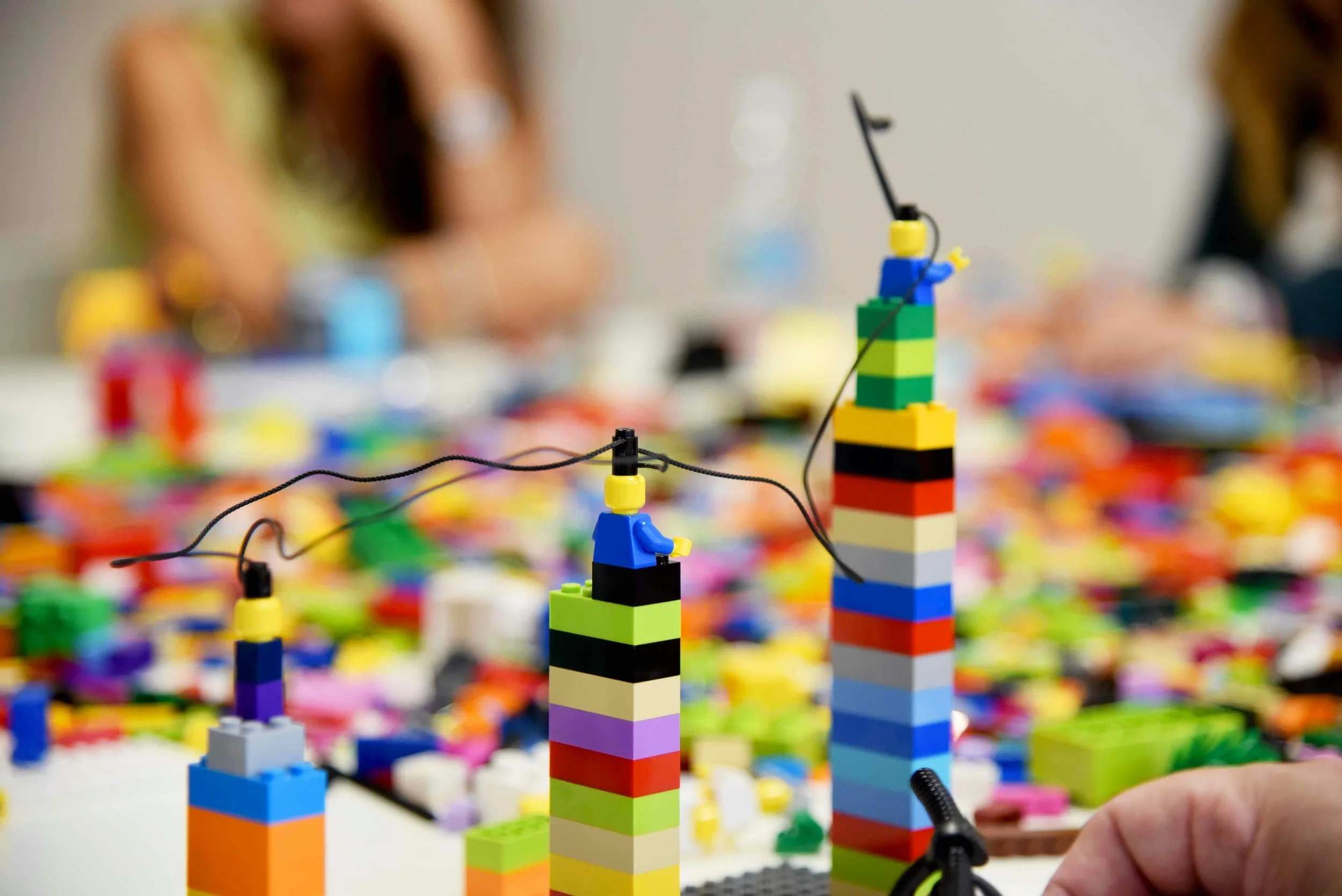
Most of what's unexpressed in a system isn't hidden because someone's keeping a secret. It's hidden because it was never in language to begin with, felt rather than argued, structural rather than spoken. LEGO® SERIOUS PLAY® is a genuinely useful instrument for this precisely because it doesn't rely on language first. A hand can build a connection someone wouldn't yet say out loud. A model can hold an assumption before anyone's tested whether it's actually true.
But we don't treat the method as automatically neutral. LSP has its own version of the unexpressed, the tidy "first-line" story everyone reaches for under time pressure, the cliché metaphor (the ladder, the bridge, the elephant) that gets accepted before anyone asks what else it might mean, the quiet pressure toward a hopeful ending because the agenda needs one. Being honest about that is part of what makes the practice trustworthy rather than a performance of openness. It's why our sessions build in real time for second-line stories, not just the first one anyone offers.
Building the System of the Unexpressed, a working playbook
Alongside the thinking, there's a growing, open playbook of applications: 36 (and counting) ways of putting the System of the Unexpressed to work through LEGO® SERIOUS PLAY®, a concept co-developed with Sean Blair, author of The Systems Synergy.
It's built in the same spirit as the original LEGO® SERIOUS PLAY® Open Source guide, offered to be used, argued with, and built on, not treated as a finished manual. Applications range from tightly staged builds to open-ended prompts with no facilitator-set structure at all, covering change and transition, power and influence, team dynamics, and individual reflection.
Every application is deliberately incomplete, and every one is designed to be run in a neuroinclusive way from the outset, not bolted on afterward.
The longer read
For anyone who wants the fuller argument, where the concept comes from, how it shows up differently across identity, role, and neurotype, and where it can quietly re-emerge inside facilitation itself, the position paper lays it out in full.
Download the position paper (available shortly)
Where this comes from
The idea of System of the Unexpressed was created by Sean Blair and Guy Stephens, drawing on organisational silence and emotional labour research, systems thinking (Ashby, Senge, Meadows), and the open-source tradition of LEGO® SERIOUS PLAY® itself. It sits underneath everything &Koh does, not as one strand among others, but as the lens the rest of the practice is built through.
Where you'll meet this in practice
Make Transition Work, the System of the Unexpressed applied to team transitions, through Block.Build.Begin. Learn more
LSP Coaching for Practitioners, Complexity Clinic and Practice Circle, where facilitators work with their own unexpressed patterns. Learn more
The Playbook, the open applications, free to use. Explore the playbook